Stop Drafting Your Team. Start Coaching Them.
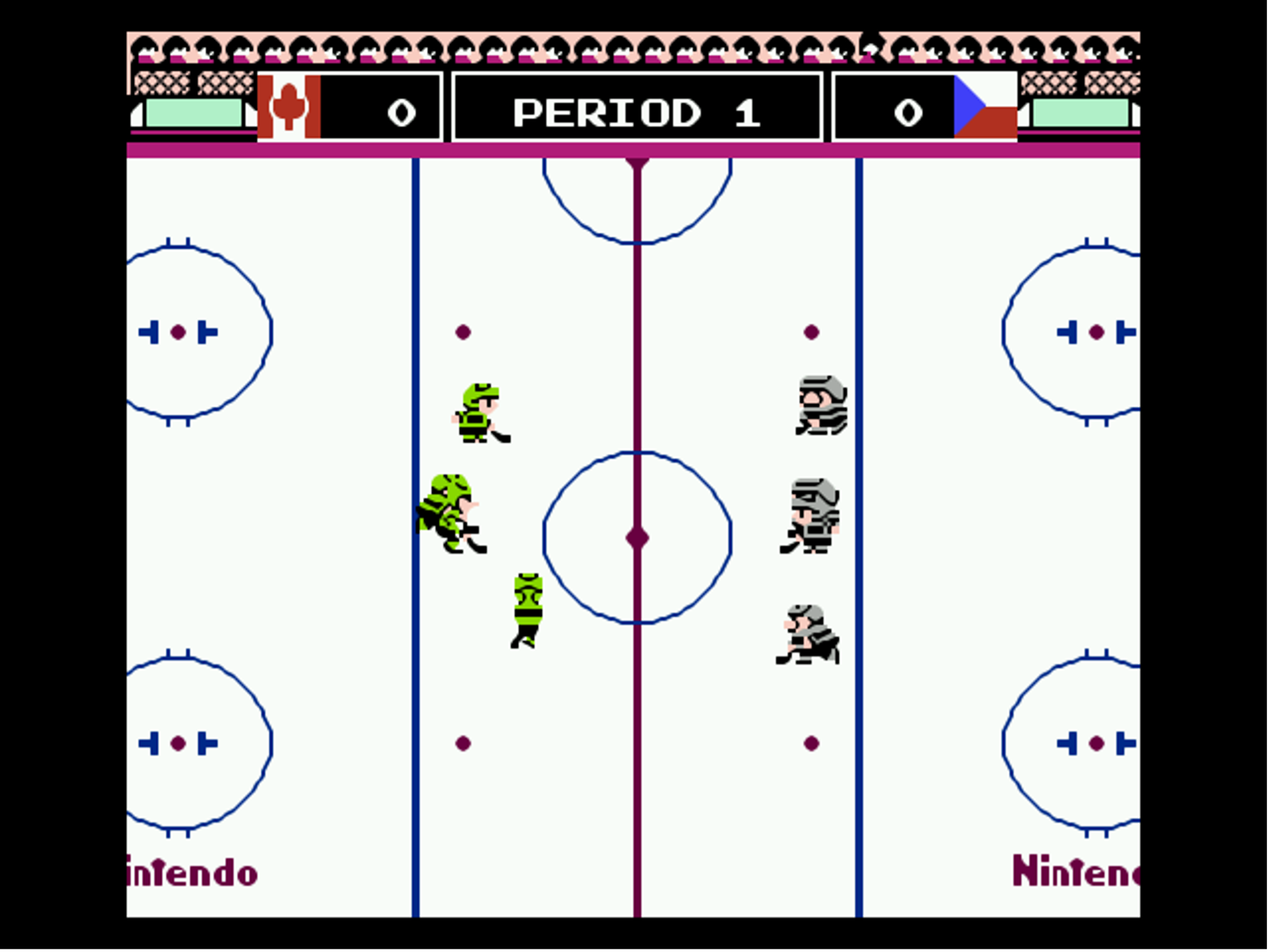
Ninetendo Ice Hockey ©1988
This might be your favorite childhood game, or you may have never picked up a controller. Either way, picture a simple sports game in typical pixelated 80s design. Before each match in Nintendo Ice Hockey, you assemble a lineup from three archetypes: Light, Medium, and Heavy players. That's it. That's the whole roster strategy.
You had the light guy, zippy, fast, impossible to catch. But when you did catch him, he'd go flying into the corner like a leaf in a windstorm. Then there was the heavy guy, slow, lumbering, but unshakable. He could flatten anyone and had a cannon of a shot. And, of course, the medium guy, steady, balanced, not flashy but dependable.
We spent hours debating the "right" mix. Two heavies, one light, one medium? Or maybe go all-in on speed? Team composition mattered a ton. And then you'd be in the third period, down by one, and you'd realize: your light guy can't hold onto the puck under pressure. Your heavy guy can't get back on defense fast enough. The medium guy's doing fine, but fine doesn't win games.
Every player has flaws. The question isn't whether they exist. The question is what you do about them.
And if you knew the Konami Code (up, up, down, down, left, right, left, right, B, A, Start), everything was amplified. Speed, power, precision. But what I always wondered was this: what if you could coach each player instead of just choosing them?
Imagine if you could help the light guy learn how to absorb a hit. Not by making him heavier, but by teaching him to see it coming and roll with it. Or teach the heavy guy to read the play, to anticipate where the puck's going so he doesn't need to be fast, he just needs to already be there. Or push the balanced player to develop one specialty. Maybe he becomes the guy who never misses the cross-ice pass, or who can kill a penalty better than anyone.
I didn't realize it then, but that little pixelated game was an early lesson in team design. The best teams aren't the ones with the perfect mix of types. They're the ones where every player keeps improving, learning, adapting, and playing to their strengths.
That's coaching and performance management in a nutshell.
Fixed Archetypes vs. Dynamic Players
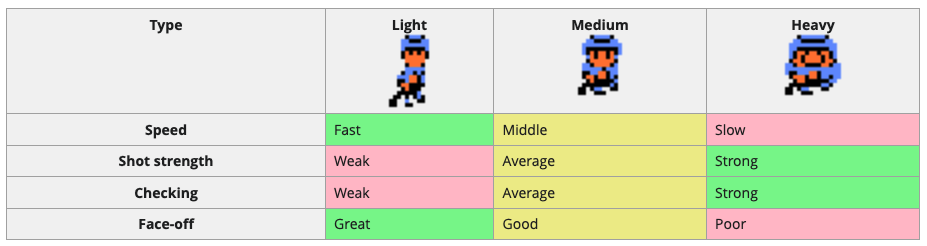
Nintendo Ice Hockey Player Archetypes
Too often, we build teams like we're drafting Nintendo players, fixed archetypes we just slot in. We treat people like static characters rather than dynamic ones capable of leveling up.
A leader inherits a team and starts labeling. "She's the closer." "He's the relationship guy." "They're solid but not standout." Six months later, they're frustrated. The closer is burning out. The relationship guy wants to build something, not just schmooze. The "solid" person is bored and looking for the door.
Because no one's coaching. They're just slotting people in and hoping it works.
Here's what I've learned: when someone's struggling, it's rarely just about them. Scratch the surface and you'll find they don't know what success looks like. They don't have the tools they need. They've never been shown how. Or they've stopped caring because no one's paying attention. The performance issue isn't the person. It's the gap between what they need and what they're getting.
In the real world, the game's not coded. The magic comes from coaching, the art of helping each person understand their strengths, adapt to the play around them, and develop range.
That's what the best leaders do. They don't draft players; they develop them.
The Performance Compass
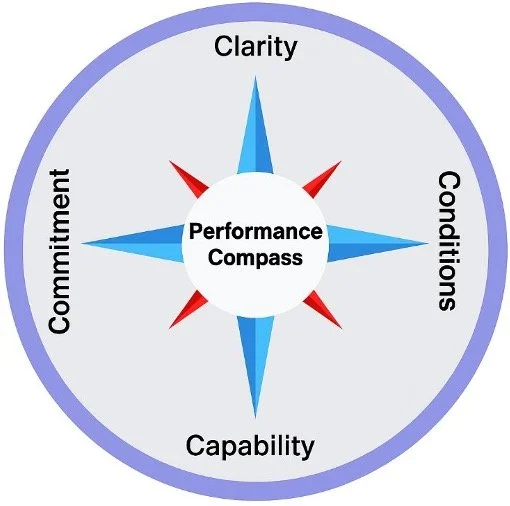
A great coach doesn't just balance the roster. They work the Performance Compass, helping each player find clarity, strengthen conditions, build capability, and deepen commitment.
Here's the truth: everyone has performance gaps, even your top performers. The question isn't whether gaps exist. The question is what's causing them.
Think of the Performance Compass as four simple lenses to diagnose team performance problems. When someone's struggling, the Performance Compass helps you identify which dimension needs attention: Clarity, Conditions, Capability, or Commitment. But it's more than a diagnostic. It's a mirror. As you move clockwise around the compass, it forces you to ask: have I done everything in my power to ensure this person is as successful as possible? If the answer is no, you've failed as a leader.
Always start with Clarity.
Clarity is about expectations and feedback, knowing what great looks like and hearing the truth about where you stand. In the game, it's simple: your job is to score, defend, or both. You know immediately if you're doing it. In real work? Leaders say "be a team player" or "take ownership" and wonder why nothing changes. Great coaches say: "When the client pushes back on price, here's exactly how I want you to respond. Let's practice it." That's clarity. When someone's missing the mark, ask yourself: have I made the target clear enough that they could hit it? The only cost here is your time and energy. If you haven't provided crystal-clear expectations and delivered feedback against those expectations, stop. Start there.
Once you've established clarity, look at Conditions.
Conditions are the systems, support, and ice time that let you perform at your best. In the game, it's literal: does your fast guy get enough shifts to stay warm? Does your heavy guy have a winger who can feed him the puck? In real work, it's: Does she have the tools, the budget, the access to make this happen? Or are we asking her to score without ever giving her the puck? When someone's struggling, ask yourself: have I set them up to succeed, or just set them up? This too doesn't usually cost money. It's about removing obstacles, providing resources, and creating the right environment. Have you done that?
If you've provided clarity and created the right conditions, then move to Capability.
Capability is the skill work, the practice, the small adjustments that turn potential into power. In the game, it's teaching the light guy to pivot away from a hit, or the heavy guy to fake the slap shot and pass instead. In real work, it's role-playing the tough conversation, reviewing the pitch together, showing someone how to read a room. It's not "figure it out," it's "let me show you, then you try." When someone's not delivering, ask yourself: have I actually taught them how, or did I just assume they'd know? This is where money starts to come into play. Training, coaching, development programs. If you've given clarity and created conditions but someone still can't execute, you may need to open your wallet.
If you've addressed clarity, conditions, and capability, and performance gaps remain, then examine Commitment.
Commitment is the drive to keep showing up, shift after shift, even when the scoreboard isn't in your favor. In the game, you see it when someone's down 5-1 in the third period and still forechecks hard. In real work, it's what happens after the deal falls through, after the launch flops, after the feedback stings. Do they come back? Do they want to get better? That's not something you can mandate. But you can build it by making people feel like their effort matters, like they're growing, like the team sees them. When someone's checked out, ask yourself: have I given them a reason to care? If you've provided clarity, created the right conditions, and invested in their capability, and they're still not committed, then you know the issue isn't about what you haven't done.
Every player has flaws. But when you use the Performance Compass, you stop asking "what's wrong with them?" and start asking "what's missing here?" Most of the time, the answer isn't about talent. It's about clarity, conditions, capability, or commitment. And the compass tells you exactly where you need to focus.
The Performance Compass doesn't guarantee everyone will succeed. But it does guarantee you'll know why they're not, and whether it's something you can fix or something you can't. More importantly, it holds you accountable as a leader for doing the work before you conclude someone isn't capable.
Making It Work
You can't coach everyone all the time. But you can use the Performance Compass to figure out where to invest your energy.
You'll know it's working when the conversations change. When "why isn't she hitting quota?" becomes "what's missing in her setup?" That shift is the leading indicator. The lagging indicators, the numbers, follow.
When coaches manage performance through that lens, the team doesn't just play better. They think differently. They adapt faster. They create solutions. They win.
Building Through Development
Because the best teams aren't built, they're developed.
That's what we believe at Business Artists: coaching isn't about fixing people, it's about helping them see the whole ice. Seeing when to pass. When to crash the net. When to hang back and create space.
Performance management isn't a spreadsheet exercise. It's a creative act. It's about shaping conditions where talent grows, confidence compounds, and every player starts to expand their range.
The secret isn't finding the perfect lineup. It's helping the people you already have play a different kind of game. And when you do bring someone new onto the team, you're not just filling a role. You know exactly what gaps they'll address and how you'll develop them from day one.
That light guy? He can learn to take a hit. The heavy guy? He can anticipate the pass. The medium guy? He can become exceptional at something. But only if someone's actually coaching them, watching them play, telling them what they're missing, helping them see the ice differently.
Anyone can pick a team. Artists coach one into existence.
So here's the question: when's the last time you actually coached someone, instead of just managing them?