You Funded the Launch. Who Funded What Comes After?
Recently, I wrote about a pattern we keep seeing play out inside revenue organizations. A GTM leader steps into a new seat. They bring in people they trust. They loop in enablement. They build the process the right way. And twelve months later they are explaining to the board why the number is not moving.
The diagnosis was this: the process was never the problem. Nobody built the managers who were supposed to carry it forward. And enablement, as good as it is at training reps, was never designed to develop managers. That is a different discipline entirely.
If you have not read that piece, it is worth starting there. You can find it here.
That article ended with a question. If you are not asking who is responsible for the second job, you already know why you are having the conversation you are having twelve months later.
This article is the answer to that question. Not another training. Not another playbook. Not another launch event with good energy and a forgettable slide deck.
Here is what the second job looks like when you do it right.
Most initiatives introduce managers and the field to the new story at the same time. Same webinar. Same deck. Same energy. And then managers are expected to go answer questions they have not had the chance to ask themselves.
That is not alignment. That is assumption.
If a manager does not have space to wrestle with the why, push back on the logic, and ask the hard questions nobody else is asking, they will never own the story. They will recite it. And a manager reciting a story they do not believe is worse than no story at all. The field can feel the difference immediately.
Managers are the culture carriers of your organization. They translate strategy into meaning for the people doing the work every day. If they cannot tell the story in their own words, with their own conviction, the initiative is already in trouble before the field ever hears about it.
Before the field sees anything, give managers their own track. Not to align them. Not to brief them. To let them grapple. Let them challenge your assumptions. Let them poke holes. The output is not a manager who agrees with you. It is a manager who owns the why because they had the chance to interrogate it.
We have been in enough of these rooms to know that the moment a manager stops reciting and starts owning the story, something shifts. It is not subtle. Everyone feels it.
But owning the story is only the beginning. The harder question is whether they know what to do with it once they are back in the field.
Most manager development stops at knowledge. Here is the new process. Here are the stages. Here is what good looks like. Here is the playbook.
And then it ends.
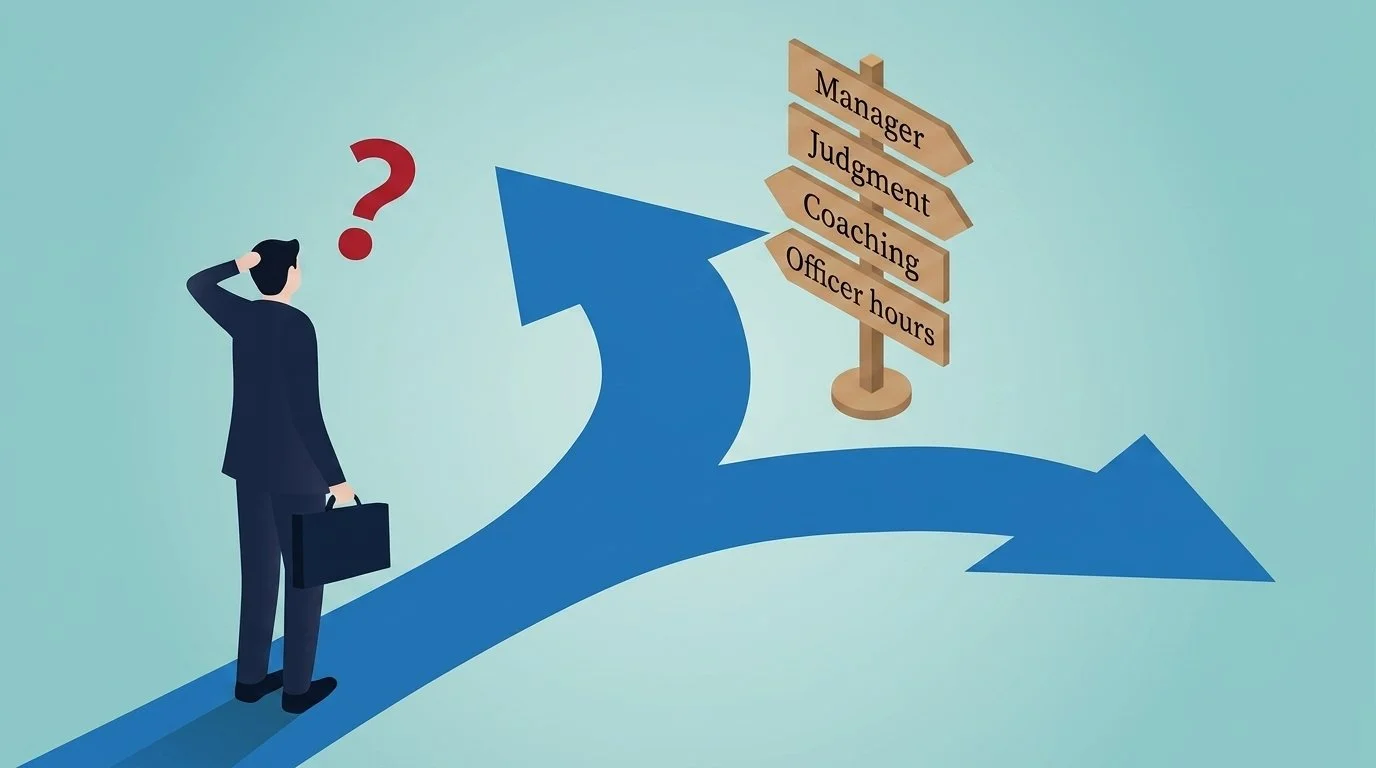
What never gets built is judgment. The instinct for when to step in as a leader and set the direction. When to manage and hold the line on execution. When to coach and create the space for the rep to find the answer themselves.
Those are not the same move. And most managers default to the one they are most comfortable with, not the one the situation needs. A manager who leads when they should be coaching never builds a team that can think for itself. And one who coaches when the rep needs someone to just tell them what to do leaves them spinning.
Judgment is not built in a classroom. It is not built by reading a framework. It is built through repetition in situations that mirror the real world. Real deals. Real rep dynamics. Real moments where the right move is not obvious and the manager has to decide.
This means creating hands-on situations based on what managers will face in the field. Not generic role plays. Not case studies from another industry. Their world. Their motion. Their team. The goal is not to teach them the process. It is to build the instinct for which hat to wear and when to switch.
That work takes time. It is not a session. It is a practice. And even with that practice in place, there is still a gap most organizations never close.
Most sales managers are coaching to the CRM.
Did you update the stage? Did you log the call? Did you get the next step on the calendar? That is inspection, not coaching. And it produces compliance, not capability.
The process does not close deals. Behavior does.
Coaching to behavior change means asking completely different questions. Not what did you do, but how did you show up. Not is the deal in the right stage, but what is the real reason it is stuck and what has to change for it to move. The process question has an answer in the CRM. The behavior question requires a conversation.
Most managers were never taught this distinction. They were promoted because they were great reps, handed a coaching guide, and pointed at their team. The guide tells them what to coach. Nobody taught them how to coach, what behavior change they are after, or how to know when the coaching is working.
Managers who own the story, who are building judgment in the field, who are trying to coach to behavior rather than process. And they are doing all of it alone. No one to pressure test their thinking. No one who has been in the same moment. No one to tell them whether what they tried last week was good or just felt like it was.
That is the gap none of the above closes. And it is the one that matters most.
Office hours just appeared on your calendar. You already know what it is. A product owner. A parade of technical experts. A customer testimonial that felt too polished to be real. A rep walking through an over-orchestrated presentation on why we win. Optional in theory. Painful in practice. You have sat through it at every company you have ever worked for and you have stopped showing up.
That version of office hours is a broadcast dressed up as a conversation. And managers everywhere have voted with their calendars.
What we are building is something most organizations have never tried.
Everything above can be designed, scheduled, and delivered. This part cannot.
Office hours is not a training session. There is no agenda. Nobody is being evaluated. The only rule is that you show up with a problem and what you tried. Not a complaint. Not a question for the facilitator. A real situation from the field, an experiment you ran, and an honest account of what happened.
The feedback comes from peers. Not from managers above them. Not from the facilitator. From the person across the table who had the same conversation last week with a different rep and a different outcome.
That is where the real learning happens. Not in the content. In the collision of experience.
Frontline sales managers are the busiest people in your organization. It is easy to make excuses for why they cannot attend. It is also true that they are the ones most starved for exactly this kind of engagement. They are isolated. They are solving the same problems in parallel without knowing it. And when you create the conditions for them to finally be in a room together without an agenda or a judgment, something shifts.
The insights from every session belong to the people who showed up. They are not distributed to the broader group. They are not summarized in a follow-up email for the people who were too busy.
If you want access to what the room figured out, you have to be in the room.
Every session ends the same way. The group, guided by the facilitator, co-creates an experiment to take back to the field. Not a homework assignment. Not a best practice to implement. An experiment. Something low enough in stakes to try without a lot of preparation. Something specific enough to generate a real result. Something the manager chose, with the group, because it connects directly to what they were just wrestling with in the room.
That experiment is the bridge to the next session. You come back with what you tried, what happened, and what you learned. That is the agenda. That is the accountability. And it belongs to the managers, not the facilitator.
The facilitator's job in the early sessions is to hold the space. Ask the question that moves the conversation forward when it stalls. Redirect when it slides toward venting. Surface the insight when the group gets close but does not quite name it. Help the group land on an experiment worth trying.
And then get out of the way.
The goal is a room that does not need a facilitator anymore. A group of managers who have built enough trust, enough shared language, and enough practice giving each other honest feedback that the session runs itself.
Most organizations would never fund that outcome. They want a facilitator on every call forever because that is what justifies the invoice.
We are building toward the room that does not need us. That is the only version of this that works.
It does not end when the initiative launches. It does not end when the training is complete. It does not end when the CRM is configured and the dashboards are live.
It runs alongside the work. One coaching conversation at a time. One experiment at a time. One office hours session where a manager walks in with a problem they have been carrying alone and walks out with three people who have lived it.
That is what compounds.
None of this shows up clean in a project plan. None of it ends with a launch event and a celebratory Slack message. None of it is easy to put on a slide for the board.
But here is what does show up. Forecasts that are accurate because managers know what is happening in their pipeline. Deal cycles that move because reps are getting real coaching, not inspection. A team that runs the play because the managers believe in it, not because the CRM requires it.
You funded the launch. Most organizations stop there and wonder why nothing changed.
Fund what comes after. That is where the work lives.